
San Saba County Court Records After Arrest
A San Saba County jail arrest and a San Saba County court record are separate records. The jail or contract facility documents the custody event: arresting agency, intake, booking photo, booking charge, bond, release, transfer, and housing status. The court file documents what the prosecutor actually filed and what the judge did with the case. A person may be physically held in Bell County or another jail while the court records after a jail arrest remain with San Saba County courts or the 33rd/424th Judicial District.
For booking details and custody status, use San Saba County jail inmate records. For booking photos, use the San Saba County jail mugshots page. For court records after a jail arrest, focus on clerks, dockets, prosecutor filings, docket numbers, charge status, bond orders, warrants, and final disposition.
Arrest Booking Court Record Path
The arrest-to-court path starts with law enforcement and ends with the clerk's case record. A person may be arrested on probable cause, a warrant, capias, bench warrant, indictment, or other process. The jail or contract facility books the person, records booking charges, and may publish bond or docket fields. A magistrate hearing follows for warnings and bond. Then the prosecutor decides what to file.
- Arrest or warrant service creates the law-enforcement record.
- Booking creates the jail record, including charge, bond, photo, and custody fields where available.
- A magistrate sets warnings, rights advisement, and bail conditions.
- The County Attorney or District Attorney reviews the case for filing.
- The clerk maintains the court case once a complaint, information, indictment, motion, or warrant case is filed.
- The court record then shows status, settings, amendments, dismissal, plea, trial, or sentence.
Find San Saba Court Records After Arrest
The statewide search path is re:SearchTX, but access can depend on account status, document type, fees, and court participation. Local clerk pages remain important for San Saba criminal case records. Felony and district matters usually route through the District Clerk and district courts. Misdemeanors may involve the County Clerk and County Court. Class C, magistrate, and some warrant matters may involve the Justice of the Peace.
| Office or Portal | Use For | Official Source |
|---|---|---|
| re:SearchTX | Statewide court search where records are available | Texas court search portal |
| District Clerk | Felony and district criminal case records | San Saba District Clerk |
| County Clerk / County Court | County-level filings and misdemeanor court context | San Saba County Clerk |
| Justice of the Peace | Class C, magistrate, and local lower-court matters | San Saba Justice of the Peace |
| County Attorney | Misdemeanor prosecution context | San Saba County Attorney |
| District Attorney | Felony prosecution in the 33rd/424th Judicial District | 33rd/424th District Attorney |
The research screenshot shows the re:SearchTX court-search portal, the statewide place to begin when a case number or party name is known.
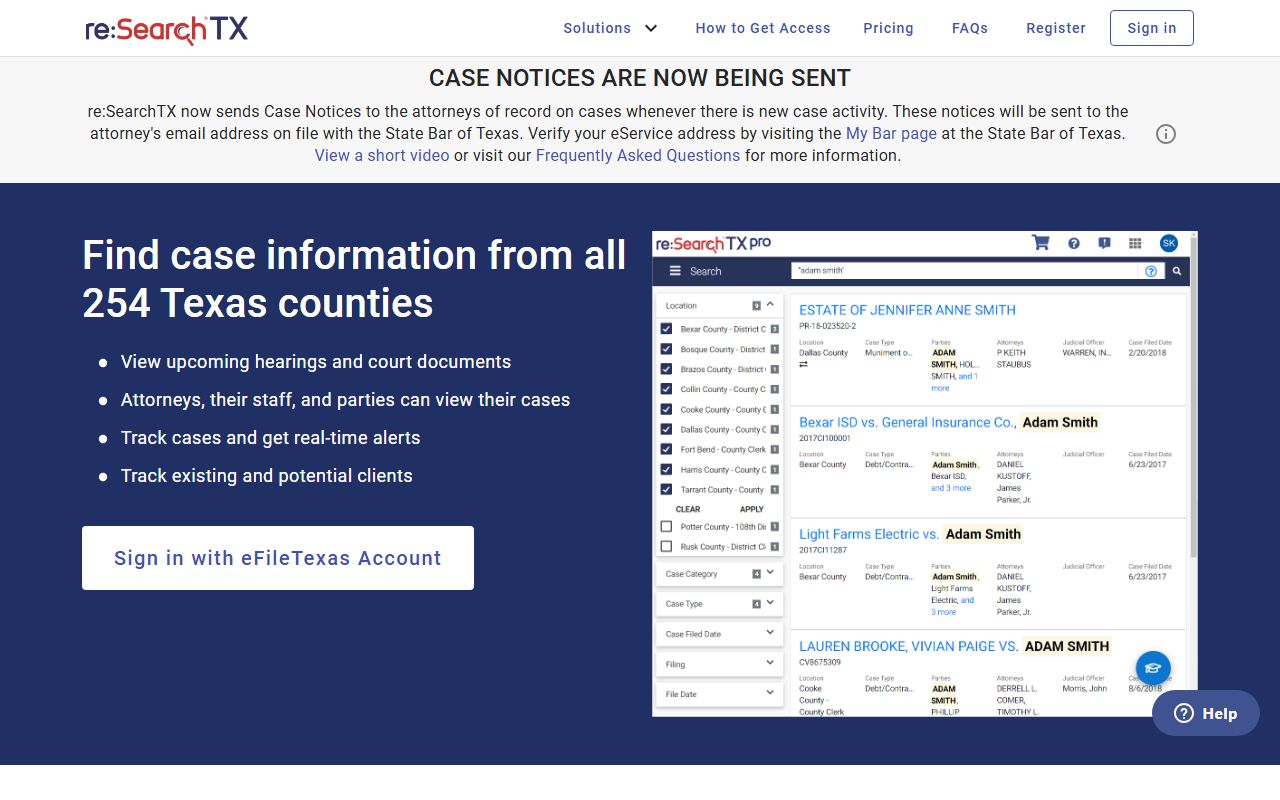
When an online search fails, use the clerk and prosecutor contacts rather than assuming no court record exists.
San Saba Court Search Fields
The re:SearchTX inspection in the research file documented broad search fields rather than a San Saba-only criminal index. The portal may accept search terms, party name, or case number, and it may support court or county filters when available. Public document access can require registration or payment depending on the court and document type.
| Field Label | Type | Required | Notes |
|---|---|---|---|
| Search terms, party name, or case number | Text | Varies | Use defendant name or a docket number from a jail profile if available. |
| Court or county filters | Filter/dropdown | Optional where available | Participation and available filters can vary. |
| Register or login | Account action | Sometimes | Some public document access may require account or payment. |
| Search | Button | n/a | Runs the court-record search. |
Charges After San Saba Arrest
The jail may list arrest charges before prosecutor review. Those charges can later be accepted, declined, amended, reduced, or presented to a grand jury. The charging document is the point where the court record becomes the controlling source for the filed charge. San Saba misdemeanor matters may involve the County Attorney. Felony matters use the 33rd/424th Judicial District Attorney structure.
| Document | Who Uses It | What It Does |
|---|---|---|
| Complaint | Officer, complainant, or prosecutor depending on context | States sworn allegations and can support a court filing or warrant process. |
| Information | Prosecutor | Charges an offense without a grand-jury indictment where Texas law allows it. |
| Indictment | Grand jury | Formal felony charging document returned by a grand jury. |
San Saba Charge Status Records
Charge status terms explain what happened after the jail arrest. A pending case is not a conviction. A dismissed charge is not the same as an expunged record. A no-bill means the grand jury did not return an indictment. A deferred adjudication is a Texas supervision result that may avoid final conviction if completed, subject to Texas rules.
| Status | What It Means | Why It Matters |
|---|---|---|
| Pending | Filed case has not been disposed. | Jail bond and court settings may still change. |
| Amended | Charge language or count changed. | The court record may differ from the booking record. |
| Reduced | Charge lowered to a lesser offense. | Final case level may be lower than the arrest allegation. |
| Dismissed | Charge ended without conviction. | The arrest record may still exist unless cleared by law. |
| No-billed | Grand jury declined indictment. | Often relevant to felony arrest records and expunction questions. |
| Convicted | Judgment or adjudication entered. | Sentenced custody may move to TDCJ after transfer. |
Bond Records After Arrest
Bond records connect the jail arrest to the court case. Texas Code of Criminal Procedure Chapter 17 covers bail and personal bond rules. The San Saba Sheriff page includes Bonds as an inquiry category, so the sheriff can help confirm bond and physical holding location. If the person is housed in Bell County, Bell County procedures may control where a bond is filed or accepted. If a case is already filed, the clerk or court may control some paperwork.
| Bond or Hold | Meaning | Record to Check |
|---|---|---|
| Cash bond | Full amount paid directly. | Jail, clerk, or court instructions. |
| Surety bond | Bail bondsman posts bond for a fee. | Jail bond desk or court filing rules. |
| Personal bond | Release on promise and conditions. | Magistrate or court order. |
| No-bond hold | Release blocked by warrant, court order, or charge status. | Issuing court and jail record. |
| Detainer | Another agency wants custody. | Holding facility and requesting agency. |
Warrants and Arrest Court Records
No official San Saba County online active-warrant list was located during the research pass. Warrant questions should be confirmed through the sheriff, the court that issued the warrant, or the clerk tied to the case. A bench warrant or capias often comes from missed court or court-order noncompliance. An arrest warrant is tied to probable cause for an offense. A search warrant is not a custody lookup.
| Warrant Field | Why It Matters |
|---|---|
| Name and date of birth | Confirms identity. |
| Warrant number | Helps the sheriff or court locate the process. |
| Issuing court | Tells where the warrant must be resolved. |
| Charge or case number | Connects jail arrest to court record. |
| Bond amount or hold agency | Explains release options after arrest. |
Charges vs Convictions
An arrest or filed charge is an accusation. A conviction is a judgment or adjudication after plea, trial, or other court process. San Saba County court records after a jail arrest should be read by status and disposition. The booking record may show the first allegation, while the court record shows whether the charge was filed, amended, dismissed, deferred, or resulted in a conviction.
| Issue | Charge | Conviction |
|---|---|---|
| Stage | Accusation after arrest or prosecutor filing | Court outcome after plea, trial, or judgment |
| Record source | Jail record and court filing | Court judgment or disposition |
| Can change? | Yes, charges can be amended or dismissed | Can be appealed or later affected by legal relief |
| Custody effect | May set bond or hold | May lead to county sentence, probation, or TDCJ transfer |
Sealed Expunged Arrest Records
Texas Code of Criminal Procedure Chapter 55 governs expunction. If an eligible San Saba arrest is expunged, covered agencies may have to destroy or return records included in the order. A sealed or nondisclosed record is different. It may be hidden from many public searches but can still be available to certain agencies under Texas law. A dismissal does not by itself erase the booking record.
| Issue | Sealed or Nondisclosed | Expunged |
|---|---|---|
| Public visibility | Restricted from many public views | Treated as removed under the court order |
| Agency access | Some official access may remain | Very limited and order-dependent |
| Typical trigger | Eligible deferred or nondisclosure scenario | Eligible dismissal, acquittal, no-bill, or statutory path |
| Action needed | Court order | Court order under Texas expunction rules |
Public Access Limits
Texas Government Code Chapter 552 creates a public-information path for county and sheriff records, but it also contains exceptions. Law-enforcement records can be affected by Section 552.108 when a release would interfere with detection, investigation, or prosecution. Juvenile records, confidential identifiers, medical information, sealed records, and expunged records can also be restricted. Court records may have separate rules by record type and court order.
Important: Verify filed charges and dispositions with the clerk or court before treating a jail arrest as a final court outcome.
Public Record Search
Sponsored Results